
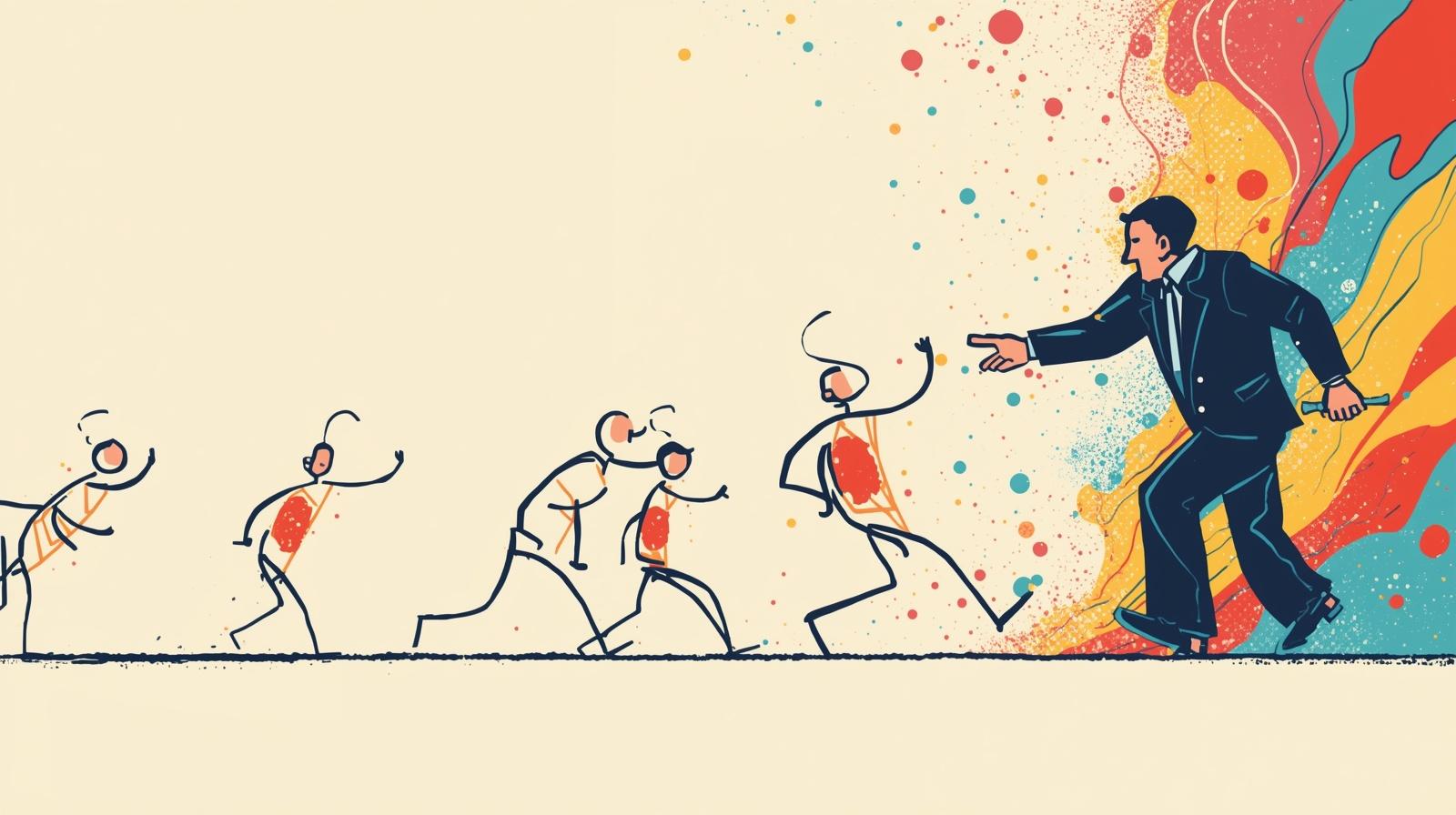
The AI Purchase Channel rewards three things: specificity, memory, and being right. New brands are built around exactly one — themselves, for one customer, said precisely. Giants are built around the opposite — many things, for many customers, said elastically. For the first time in twenty years, scale is a structural disadvantage in a major buying channel.
Slingso, Why new brands win the AI Purchase Channel — and giants don’t
Ask ChatGPT, Gemini, and Perplexity the same question — “a daily multivitamin a 35-year-old runner with a sensitive stomach should take” — and each one returns the same brand in the recommendation slot. The brand is Athletic Greens. Across the three assistants we ran the query through this week, AG1 was the named recommendation in seven of nine runs. Centrum, the category leader by retail volume for the last forty years, was named in zero. Centrum was in the encyclopaedia preamble — “popular multivitamins include…” — and then skipped. The recommendation went to the challenger every time.
This is not a freak result. We see the same pattern across categories. Olipop, not Coca-Cola, in “a functional soda alternative for someone trying to cut sugar.” Ridge Wallet, not the major luggage brands, in “a minimalist wallet for a man who carries five cards.” Brooklinen, not Pottery Barn, in “DTC bedding at the $200 price tier.” The pattern is so consistent it stops being an observation about specific brands and becomes a finding about the channel.
The AI Purchase Channel is the first major consumer buying channel in twenty years where being a giant is a structural disadvantage. Not a temporary disadvantage — a structural one. The reasons are mechanical, not stylistic. This essay names them.
What does the channel reward?
The AI Purchase Channel rewards three things, consistently, and the inverse holds across enough categories and platforms that we treat it as load-bearing rather than anecdotal. It rewards specificity — the brand that reads as exactly the answer to a precise persona-and-scenario combination beats the brand that reads as a generic category answer. It rewards memory — the brand that has been described, cited, and recommended in the assistant’s training and retrieval substrate compounds; the brand that has aggregate mind-share but no per-persona memory does not. And it rewards being right — the brand whose owned content makes claims that are precise, current, and verifiable wins over the brand whose copy is elastic and aspirational.
Below, each of the three in detail — and why, mechanically, new brands tend to have them and giants tend not to.
Specificity: why being narrow wins
When an AI assistant returns a recommendation, the most useful recommendation is the most specific one. A shopper asking “a daily vitamin C serum under $40 that won’t react with retinol” is not asking for a category. They have already chosen their category. They are asking for the brand that is exactly that sentence. The assistant’s job, structurally, is to surface the brand whose narrative most closely matches the shopper’s brief — and to do it confidently enough that the shopper acts. The same logic holds in the delegated mode, where a personal AI agent — OpenClaw, Hermes, a custom build — reads the brief and selects on the brand’s behalf. The agent is even less forgiving of generic positioning than the human in the conversation, because the agent has no taste to fill the gaps with.
Giants are bad at this for a reason that has nothing to do with their marketing capability. They are bad at it because they sell across personas, price tiers, and scenarios. A horizontal brand cannot be “exactly that sentence” for any one shopper — it is, by construction, an averaged answer for many shoppers. Procter & Gamble cannot be the recommendation for “sensitive skin, considered skincare, under $40, 35-year-old runner” because P&G is many brands and many price tiers and many personas at once. The assistant sees that horizontal positioning and reads it as generic. Generic gets mentioned in the preamble. Specific gets the recommendation.
Challengers are built differently. A typical DTC challenger is built around one sharp specificity — one persona, one product, one claim — because that’s the only way a new brand can break in. They spent their first five years getting exactly one sentence to be precise. That precision, which was a survival strategy in pre-AI distribution, becomes a structural advantage in this channel. The assistant reads “sharp” and lifts it. AG1 reads as “the considered, premium-priced, single-product multivitamin for the optimisation-minded adult.” Centrum reads as “a multivitamin.” Both are accurate descriptions. Only one is the recommendation.
Some giants have recognised this and built specific sub-brands inside their portfolio — that works. But the sub-brand has to be the specific narrative; if the model perceives it as a corporate appendage, the parent’s horizontality contaminates the recommendation. The brand teams at giants that have moved deliberately to surface their sharpest sub-brand into the AI Purchase Channel — without parent-brand bundling — are the rare incumbents who hold position here. Most haven’t moved.
Memory: why “we exist” doesn’t compound
Assistants maintain memory across three layers: within a session, across sessions for logged-in users, and across the model’s training and retrieval substrate. A brand recommended once is more likely to be recommended again to the same shopper. A brand recommended consistently across the third-party content that feeds the model’s training has memory inside the model itself.
The second layer is where giants thought they had a structural advantage and don’t. Aggregate brand recall — the kind of recall that Centrum has built over forty years of TV and shelf presence — is not the same as recommendation memory. The assistant doesn’t condition on aggregate awareness. It conditions on what’s been said about the brand inside the corpus it was trained on and the retrieval stack it queries in real time. A brand that has been described in third-party content in vague, aggregate terms (“Centrum is a popular multivitamin”) accrues vague, aggregate memory. A brand that has been described in third-party content in specific terms (“AG1 is the multivitamin chosen by athletes for its bioavailability and clean ingredient profile”) accrues specific memory. Both have memory. Only the second kind is what gets retrieved when the shopper asks a specific question.
Specific memory compounds. Once AG1 has been cited in twenty pieces of authoritative content as “the multivitamin for athletes with sensitive stomachs,” every new content piece that references the category tends to use the same framing — because the writers themselves now believe it, and because the model amplifies the consensus. That feedback loop is how memory accelerates in this channel. Brands with no specific memory have no equivalent feedback loop. They have impressions, not memory.
Challengers, again by construction, accrue specific memory faster. They start out being talked about in narrow, sharp terms because that’s the only way niche media will cover them. By the time they are five years in, they are the named brand for a specific use case in the model’s training corpus. Giants who spent five years buying broad media impressions have aggregate recognition but no specific memory for any single persona-scenario combination. The investment compounded in the wrong substrate.
Being right: why precise claims beat aspirational ones
The assistant has incentive to be accurate. Its core product promise — that the answer it gives is trustworthy — depends on it. So the assistant will lift specific, verifiable claims and improvise around vague, aspirational ones. A brand whose product page reads “15% L-ascorbic acid serum, pH 3.2, no fragrance, no parabens, formulated for sensitive skin in the 30s, $52” gives the assistant a complete claim to anchor on. The assistant can return that claim verbatim and stand behind it.
A brand whose product page reads “a luxurious vitamin C experience for radiant, ageless skin” gives the assistant nothing to anchor on. The assistant will summarise, paraphrase, or omit — and when the shopper asks the specific question, the brand with the precise claim wins because the assistant has something to say.
Giants tend toward aspirational copy for a defensible reason: it works in TV, on packaging, in print, and on shelf. Aspirational language is the right tool for a one-to-many media surface. The AI Purchase Channel is not a one-to-many surface. It is a recommendation surface with two readers in one interaction — the human, who reads emotionally and stays in the conversation, and the AI, which reads literally and decides on evidence. Aspirational copy lands for the first reader and disappears for the second. The brand whose website says “experience the magic of clean beauty” loses to the brand whose website says “8% mandelic acid, 2% azelaic acid, formulated to address adult acne in skin over 30.” One is a feeling. The other is an answer. The second reader — the AI — only retrieves answers.
The cost of aspirational copy doubles in the delegated mode. When the buying job has been handed to a personal AI agent, there is no human in the loop to fill in the aspirational gaps with their own taste. The agent reads the product page literally, scores it against the shopper’s brief, and moves on if the page is empty of specifics. Brands that built their voice for the human reader and skipped the literal reader will be partially invisible in the assisted mode and entirely invisible in the delegated mode.
Challengers, again because of the way they were built, tend to write closer to specification than to aspiration. Founders writing copy with no agency budget tend to be literal — describing what the product is, who it’s for, what’s in it, why it works. That literalness, which often looked unsophisticated next to the giants’ polished marketing, becomes the AI-readable language the channel rewards. The assistant reads literally. It rewards brands that have written literally.
The horizontal-positioning trap
There is a deeper, structural reason giants struggle here that is worth naming directly. The trap is this: a giant’s positioning cannot be made sharp without abandoning the rest of the portfolio’s revenue, and the rest of the portfolio’s revenue is what made it a giant in the first place.
Consider a hypothetical: a beauty conglomerate that sells fifteen brands across skincare, haircare, colour, and fragrance. Each brand spans multiple personas. The conglomerate’s own corporate narrative spans all of them. It is, structurally, an averaged story about beauty for everyone. It cannot rewrite itself as “considered premium skincare for the 35-year-old runner with sensitive skin” without making the other fourteen brands’ positioning incoherent.
The conglomerate could narrow one of its brands. But that brand will be read by the assistant in the context of the parent — the parent’s reviews, the parent’s third-party coverage, the parent’s website architecture. Unless the sub-brand is fully decoupled — independent domain, independent owned media, independent third-party authority — the parent’s horizontality bleeds into the sub-brand’s reading. The recommendation goes to the brand that doesn’t have a horizontal parent attached.
This is why a small set of giants have started spinning their sharpest sub-brands into editorial independence inside their own portfolios. It is also why most haven’t, and won’t — because doing it requires accepting that the brand-equity work being done at the parent level is the problem, not the asset. That is a hard conclusion for the parent’s brand team to deliver to a board.
There is an exception, and it’s instructive. Anker, a giant by revenue and category dominance in consumer electronics accessories, wins reliably in the AI Purchase Channel in queries like “the best fast charger for a 16-inch MacBook Pro” or “a durable USB-C cable that won’t fray.” Anker wins because every product in their line is specifically claimed — wattage, port type, certification, exact device compatibility. They are a horizontal company in revenue but a vertical company in product-level positioning. Each SKU reads as the answer to a specific shopper question — and the SKU pages are dense with the kind of structured claims an AI agent in the delegated mode can lift verbatim. That is what the channel rewards, regardless of company size.
Most giants do not have Anker-style per-SKU positioning discipline. They have category-level aspirational positioning. The channel reads the difference.
Can incumbents recover?
Yes, but the work is uncomfortable and the window is short.
The recovery move is not a marketing campaign. It is a positioning surgery — pick three to five persona-scenario combinations the brand intends to own, rewrite the owned content (product pages, schema, FAQ, reviews) to be the precise answer for those combinations, get third-party authority sources to use the same specific framing, and let the assistant re-read the brand over the next quarter. Most incumbents who attempt this discover, somewhere in week two, that they don’t internally agree on which persona-scenario combinations they want to own. The strategy work has been deferred because the prior channels (Google, Amazon, retail) didn’t punish ambiguity. This one does.
The brands moving on this work in 2026 will hold a defensible position by 2028. The brands that wait — until SoV dashboards visibly drift, or until revenue lines start to bend — will be entering the channel at a point where the assistants have already named their preferred recommendations for the persona-scenario space, and overtaking that memory is more expensive than building it from scratch was.
This is not a counsel of doom for incumbents. It is a counsel of urgency. The brands with the most to lose are also the ones with the most owned-content surface to work with — the most product pages, the most third-party press, the most review volume to influence. Used deliberately, those assets accelerate the recovery work that a challenger would have to build from zero. But used as they are — as aggregate-impression vehicles, not as per-persona narrative anchors — they reinforce the horizontal-positioning trap and make the recommendation slot harder to win.
What this means for challengers in 2026
For a new brand in 2026, this channel is the first major distribution opening in twenty years where the rules are not stacked against you. Scale is not a moat here. Aggregate brand recall is not a moat. Domain authority in the search-era sense is not a moat. The moats are specificity, accrued specific memory, and precise owned content — three things a focused founding team can build in eighteen months, where the analogous work in Google SEO took a decade and the analogous work in retail distribution took longer.
The strategic implication is sharper than “AI is important.” The implication is that the brand’s positioning needs to be readable as one specific sentence — not five sentences, not a brand book, one sentence — and that everything the brand publishes needs to reinforce that sentence with verifiable specificity. Founders who already operate this way have an unfair tailwind. Founders who built their brand around aspirational positioning because that’s what worked in social and influencer channels need to make a decision: sharpen the positioning to one specific sentence, or accept that the AI Purchase Channel will recommend somebody else.
For brand teams reading this who are not founders but are inside a $1M–$50M DTC brand — the move is the same one a founder would make. Pick the three persona-scenario combinations you intend to own. Rewrite the product pages, the schema, the FAQs, the third-party-pitched stories to be the precise answer for those combinations. Measure Narrative Accuracy across the assistants. Measure Purchase Likelihood across personas, across both the assisted and delegated modes. Repair the worst cell. The work is not glamorous. It is exactly the work that compounds.
Twenty years from now, the brands that won the AI Purchase Channel in 2026–2027 will be telling the story the way the brands that won Google in 2004–2005 tell theirs now: “We were specific when everyone else was generic, and we wrote literally when everyone else wrote aspirationally, and the channel rewarded us for both.” That story will be unimpeachable in hindsight and obvious in retrospect. It is available, today, to brands that move on it.
The giants will mostly not move. Some will. The ones that do will spin sharp sub-brands, write per-SKU like Anker, and treat their parent identity as background context rather than foreground claim. They are the exceptions, and the exceptions know who they are. The rest will spend the next decade buying customers in a channel that has already chosen who it recommends.
Frequently asked
Why do new brands win the AI Purchase Channel? For three structural reasons. The channel rewards specificity (a precise answer to a precise persona-scenario query), and new brands are built around exactly one specificity by construction. It rewards memory (citation in the model’s training and retrieval substrate), and new brands accrue specific memory faster than giants accrue specific memory — even when giants have more aggregate awareness. And it rewards being right (precise, verifiable claims), and new brands tend to write closer to specification than to aspiration. Giants are structurally horizontal — they sell across personas — and the channel reads horizontal positioning as generic, in both the assisted mode (where a human is in the conversation) and the delegated mode (where a personal AI agent acts on the shopper’s behalf).
Are giants permanently disadvantaged in the AI Purchase Channel? No, but the recovery work is positioning surgery, not a marketing campaign. The giants who win here either spin sharp sub-brands with editorial independence from the parent or operate Anker-style per-SKU discipline where every product is its own precise claim. Most giants haven’t done either. Those that do, do well. (Read the AI Purchase Channel Field Guide for the channel mechanics.)
What is “specific memory” versus “aggregate brand recall”? Aggregate brand recall is the awareness a brand has built across all impressions — the kind of recall a forty-year-old multivitamin brand has from TV, shelf, and print. Specific memory is the citation pattern a brand has built inside the third-party content that feeds an assistant’s training and retrieval substrate, for a specific persona-scenario combination. The AI Purchase Channel retrieves specific memory and ignores aggregate recall. Brands that invested in aggregate-impression media have recall the channel doesn’t read.
Why does precise copy beat aspirational copy in this channel? The channel has two readers inside one interaction: the human, who reads emotionally, and the AI, which reads literally. The AI lifts specific, verifiable claims and improvises around vague ones. A product page that lists ingredients, concentrations, target persona, and price gives the AI a complete claim to recommend. A product page that promises “luxurious experience” and “radiant skin” gives the AI nothing to anchor on. The cost of aspirational copy doubles in the delegated mode, where the AI agent reads the page on the shopper’s behalf and there’s no human in the loop to fill the gaps with their own taste. (Read why Purchase Likelihood — not visibility — is the channel’s revenue metric.)
What is the “horizontal-positioning trap”? A giant’s positioning, by construction, spans many personas, price tiers, and scenarios — that’s what made it a giant. That horizontality cannot be made sharp without abandoning the rest of the portfolio’s revenue. So the giant either lives with the channel reading it as generic, or spins independent sharp sub-brands that decouple from the parent. The trap is that the same brand work that built the giant’s scale advantage in prior channels is the obstacle to its position in this one.
How long is the window for new brands to win this channel? Roughly eighteen months from now. The brands that move on persona-specific positioning, narrative accuracy, and per-persona content depth in 2026 will have accrued specific memory in the assistants’ substrates by 2027, and that memory will be expensive to overtake in 2028. The next-decade winners get named in the next twelve to eighteen months. After that, the channel will be more like Google or Amazon — entrants will pay to displace incumbents who got there first.
Where do challengers start? With the operator’s first-thirty-days protocol from the Field Guide. Three to five personas. Five to ten scenarios per persona. Baseline Narrative Accuracy and Purchase Likelihood across ChatGPT, Gemini, Perplexity, Google AI Overviews. Pick the worst cell. Ship one specific narrative repair. Re-measure. Compound. The work is the work. (Read the Field Guide for the full month-one playbook.)
Companion essays:
- The AI Purchase Channel: A Field Guide — the editorial flagship and full channel definition.
- Purchase Likelihood vs Visibility and Ranking — the revenue-layer metric.
- Narrative Accuracy vs Share of Voice — the brand-value-layer metric.
Slingso is the AI Purchase Channel Manager — the AI team member your brand onboards as the dedicated owner of the channel. Monitor → Analyse → Create → Approve → Measure, continuously.