
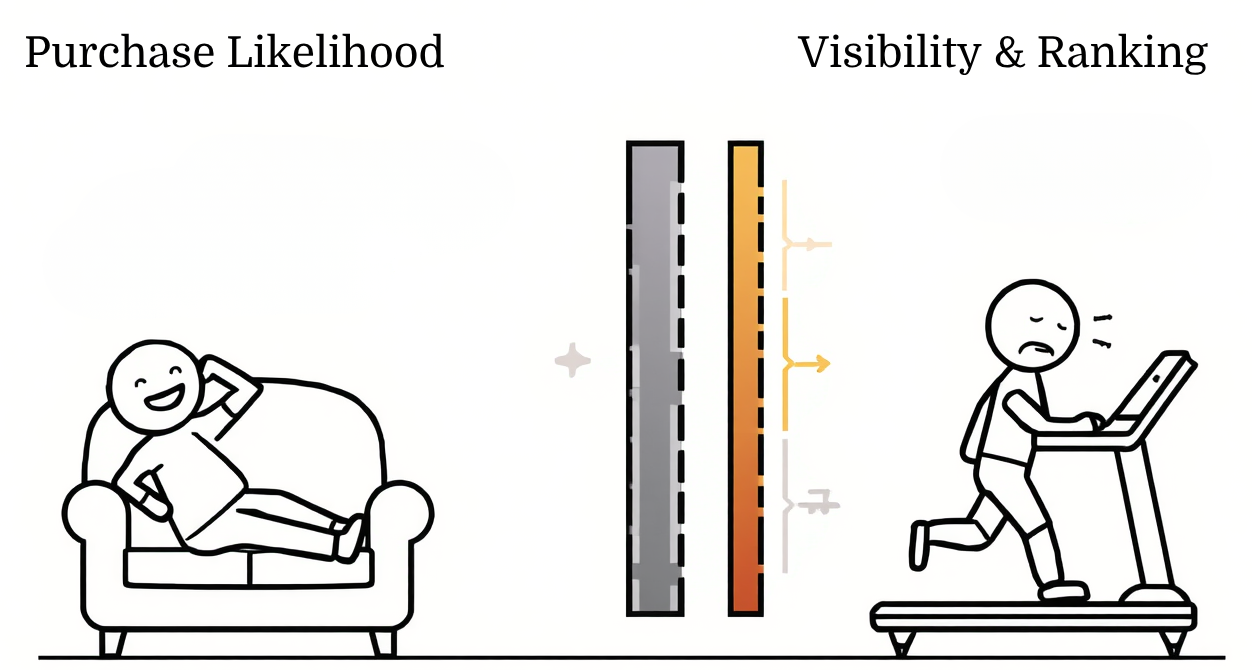
“Purchase Likelihood is the probability that, in the AI Purchase Channel, an AI assistant recommends your brand to a real shopper — or a personal AI agent selects it on the shopper’s behalf — for a real query. It is per-persona, per-platform, per-scenario. It is the closest measurable proxy for revenue from the channel — and it is what visibility and ranking metrics, inherited from search, were never built to measure“
A skincare brand we’ll call Brand A runs an AI-monitoring tool. The dashboard shows Brand A is mentioned in 78% of AI assistant responses to category queries about vitamin C serums. It ranks in the top three across ChatGPT, Gemini, and Perplexity. The marketing team is pleased. The dashboard says they’re winning.
Their Purchase Likelihood for the same scenario, on the same platforms, is 4%.
These two pictures describe the same brand on the same day. Only one of them is correlated with revenue. The brand’s team is reporting the wrong one to the CMO every week, and the CMO is making decisions on a number that sounds good and means little. This is the most expensive measurement mistake in the AI Purchase Channel today, and it is being made at most of the brands that have started taking the channel seriously. The instrument has been imported wholesale from the search era. The search-era metrics do not work here.
This essay is a tight argument: visibility and ranking — the inherited measurement stack from Google and Amazon — are the wrong primary metric for AI Purchase Channel work. Purchase Likelihood is the right one. The difference is the difference between knowing the channel exists and actually winning revenue from it.
What visibility and ranking actually measure
Visibility and ranking metrics share a lineage. They were built for media markets where appearance bought consideration. On Google in 2014, if you ranked first for a query, you appeared above the fold. The shopper saw you. The shopper might click. Ranking bought eyeballs, eyeballs bought clicks, clicks bought consideration. The metric was upstream of the goal in a clean, monotonic chain.
Visibility for AI tools mostly reproduces that logic. “Does the AI mention us in this response set?” counts as appearance. A brand that gets mentioned in 78 of 100 ChatGPT responses to a category query has 78% visibility. Ranking, layered on top, asks where in the response set: top three, top five, anywhere. The dashboard renders these numbers and says we are winning if they go up.
The category that made these metrics useful was a list-format channel. Search returned ten links. Amazon returned twenty product cards. Inside a list, position and presence determined the next click. The shopper acted on the list.
The AI Purchase Channel does not work this way. AI assistants in this channel are opinionated by default — they return one or two recommendations, not ten ranked candidates. ChatGPT might describe eight serums in answer to a question, then conclude with “For your specifications, I’d suggest X.” Perplexity will mention seven brands inside the body of an answer and put one in the bolded recommendation. Gemini will list six and explain why one is the right pick. The shopper sees the eight, the seven, the six. They act on the one.
Visibility scores the eight. Ranking debates whether you’re third or fifth in the eight. Purchase Likelihood scores the one.
What Purchase Likelihood actually measures
Purchase Likelihood asks a tighter question: in the run of real shopper queries that constitute the AI Purchase Channel, how often does the channel direct the shopper to you — in language or behaviour that signals selection, not just description? The number lives between 0 and 1, or 0 and 100 depending on how a vendor scales it. It is per-persona, per-scenario, per-platform.
A clean Purchase Likelihood measurement requires three things visibility and ranking do not.
First, a defined scenario. Not “vitamin C serum.” Something a real shopper says: “I’m 38, sensitive skin, looking for a daily vitamin C serum under $40 that won’t react with my retinol routine.” Visibility averages across all queries and produces one number. Purchase Likelihood is per-scenario by design. The same brand can have 80% PL in “premium skincare for sensitive 30s” and 0% PL in “budget skincare under $20.” Both are true. Both are actionable. The averaged number is neither.
Second, a defined persona. The same scenario asked by a different persona returns a different answer because the AI conditions on context. A query framed as “recommend the dermatologist favourite” returns different brands than one framed as “budget-conscious, sensitive skin.” Visibility doesn’t see the persona; it counts mentions across all of them. Purchase Likelihood is per-persona because the recommendation behaves per-persona.
Third, a selection classifier. A second-pass step — usually a model call — that distinguishes “the AI named this brand” from “the AI directed the shopper to this brand.” In the assisted mode, this is the recommendation language: description (“Brand X is a vitamin C serum that contains 15% L-ascorbic acid”) versus recommendation (“I’d suggest Brand X for your specifications”). In the delegated mode, the equivalent is the agent’s action: the click, the add-to-cart, the purchase that the personal AI agent took on the shopper’s behalf. Different mechanism, same question — did the channel pick you, or did it just list you? Visibility counts both as appearances. Ranking sometimes treats them differently and sometimes doesn’t. Purchase Likelihood counts only the selection.
Run the same brand across the same platforms with the same monitoring frequency, and Purchase Likelihood will produce a smaller, harder, more decision-relevant number than visibility or ranking. It will often be a much smaller number. That is not a bug. That is the entire point.
Why the difference is load-bearing for revenue
The reason a 78%-visibility brand can have a 4% Purchase Likelihood is structural. The AI Purchase Channel returns one or two selected options, not ten ranked links. Mention is cheap; selection is scarce. The mention layer behaves like a category encyclopaedia: the assistant lists what’s in the category. The selection layer behaves like a single-shot decision: the assistant picks who gets the shopper (in the assisted mode), or the agent picks who gets the order (in the delegated mode).
So when a brand team optimises for visibility, they are optimising the encyclopaedia layer. They are buying themselves more mentions in the model’s “here’s what’s in the category” preamble. That work is real, but it is upstream of the question that determines revenue. The question that determines revenue is who gets picked. The encyclopaedia layer is hygiene; the selection layer is the channel.
Ranking is a slightly more sophisticated version of the same mistake. Ranking asks: given that you’re in the encyclopaedia, where in it? The hidden assumption is that position inside a list correlates with selection. In a list-format channel (Google, Amazon), it does. In a recommendation-format channel, it doesn’t. Position three in the AI’s category preamble is not closer to being the recommendation than position seven; both are in the preamble, neither is the recommendation. The ranking dashboard is a search-era instrument used in an answer-era channel.
There is one more layer worth surfacing. Purchase Likelihood is correlated with revenue because being selected is what causes the transaction to happen. In the assisted mode, the conversion event is the assistant saying “I recommend X” and the shopper pursuing X. In the delegated mode, the conversion event is the agent acting — clicking, adding, purchasing — on behalf of the human. Brands that show up in the comparison preamble of the assistant’s response sometimes get reconsidered and sometimes don’t; brands that get the selection slot are dramatically more likely to convert. The ratio of “got selected” to “appeared somewhere in the response” varies by category, but it is rarely close to 1:1. Most of the time it is 1:5 or 1:10. PL captures the 1; visibility captures the 5–10. Only the 1 sends a shopper to the brand.
PL across the two modes
The AI Purchase Channel has two modes of offload — assisted and delegated — and PL has to work for both, because both produce revenue and a brand running the channel seriously needs to see both.
In the assisted mode, PL is measured against the assistant’s recommendation language: the bolded suggestion, the “for your specifications, I’d choose” sentence, the answer the human reads and acts on. The selection classifier is reading text and tagging recommendation-vs-description.
In the delegated mode, PL is measured against the agent’s behaviour: did the personal AI agent click through to the brand, add to cart, complete the purchase, or surface the brand to its human as the recommended option? The classifier here is observing actions, not parsing language. The mechanism is different. The question is the same: did the channel send the shopper to this brand, or merely list it?
Today, the assisted mode dominates the measurable volume — agentic shoppers are real and growing, but not yet the largest source of channel revenue for most categories. By 2027, the delegated share is large enough that a PL measurement that ignores it is missing meaningful revenue. A brand team that builds PL measurement only for the assisted mode in 2026 is building an instrument that needs to be re-built within twelve months. Better to define PL as cross-mode from the start — recommended in assisted, selected in delegated, both flow into the same per-persona-per-scenario-per-platform number — and let the underlying mix shift as the delegated share grows.
Five ways visibility and ranking deceive operators
We’ve now run audits across enough brand teams to see the same five failure modes recur.
1. The plateau hides the gap. Once a brand is ambient in the category — meaning the model knows it exists — additional visibility gains require more work for less return. A brand at 78% visibility is not three times more recommendable than a brand at 26%. The PL gap between them is often smaller than the visibility gap, because both are inside the recommendation candidate set; the model is choosing among them on different criteria entirely. A team optimising visibility past the ambient threshold is buying nothing.
2. Ranking position becomes theatre. Brands move from position five to position two in the AI’s mention ordering and the dashboard treats it as a 60% improvement. The model didn’t recommend either of them. The improvement is theatrical — visible to the dashboard, invisible to revenue.
3. Description-language mentions get credited as recommendations. The AI says “Brand X is a popular vitamin C serum” and visibility scores the same as “I’d recommend Brand X.” Operators read the number and feel rewarded; the model is in fact treating the brand as a category fixture, not as a recommendation. Without a selection classifier, the metric overstates.
4. Persona-specific signal averages into noise. A brand can have a 95% PL for “anti-ageing skincare for 50+, sensitive skin, premium pricing” and a 0% PL for “vitamin C serum, 25-year-old, under $30.” A unified visibility number averages those into a meaningless mid-figure that conceals the actionable truth: the brand is winning one persona and invisible to another. PL surfaces the asymmetry. Visibility buries it.
5. Visibility improvements don’t move revenue. This is the one operators feel last and worst. The team spends a quarter pushing visibility up six points. Revenue from AI-driven traffic does not move. The team starts to suspect the channel “doesn’t work.” The channel works. The team measured the wrong thing and optimised for the wrong layer for ninety days.
How to read Purchase Likelihood — the operator’s guide
A clean PL report has four readable axes. We’ll publish a longer playbook on this; the operator’s quick read is straightforward.
By platform. Purchase Likelihood on ChatGPT, Gemini, Perplexity, and Google AI Overviews will not be the same number. They condition on different training data, retrieval stacks, and recency windows. A brand can have 60% PL on Perplexity and 12% on ChatGPT for the same scenario. That is information, not noise. Different platforms recommend on different evidence. The work is different.
By persona. Read PL across your three to five core personas. A brand that is “winning the channel” is a brand whose PL is concentrated in the personas it intends to serve. A brand whose PL is even across all personas is usually a brand that doesn’t have a positioning the AI is detecting — it reads as generic to the model.
By scenario. Within a persona, read PL across the five-or-so purchase-intent scenarios that matter most. A brand can be the recommendation for “ingredient-conscious daily routine” and absent from “first-time buyer, gift purchase.” That gap is a content brief — it tells the team what narrative is missing for a specific persona-scenario combination.
By delta over time. The most useful PL reading is the trend. A brand whose PL is climbing on ChatGPT and falling on Gemini is being read differently by the two providers — usually because one provider has indexed a new third-party source that the other hasn’t. That delta is the breadcrumb to the next investigation.
The brand team’s monthly read becomes: which persona × scenario × platform combinations am I winning, which am I losing, and which is the work for next month? That is a real meeting. Reading visibility in the same meeting produces motion without information.
What this changes about reporting up
Brand teams that report visibility to a CMO are giving the CMO a number that goes up smoothly and means little. Brand teams that report PL are giving the CMO a number that’s smaller, sometimes flat, occasionally surprising — and is correlated with revenue. The first conversation is comfortable. The second is useful. CMOs run businesses on the second kind of number, eventually. The teams that switch first will report better data sooner; the teams that don’t switch will spend a year wondering why the AI channel “isn’t producing.”
A team that has switched from visibility to PL also stops needing to explain why the AI channel isn’t producing. When the metric tracks the actual mechanism (the channel’s selection), an underperforming month has a diagnosable cause. When the metric tracks appearances (visibility), an underperforming month is theatrical: the surface signal is fine, the revenue is missing, no one knows why.
Switching reports is also a category move. Every brand team that asks its monitoring vendor for “PL by persona by platform, across assisted and delegated” makes the AI Purchase Channel slightly less misreadable as a search-era surface. Vendors will ship what their customers ask for. The dashboards that currently report visibility will, eventually, report PL — because brand teams will demand it. The teams that demand it first get the information first.
What this essay does not cover
This essay is about the revenue layer of measurement. Purchase Likelihood is the metric that maps to revenue. It is the closest measurable proxy for who wins the selection slot, across both modes of the channel.
There is a second layer the channel demands: the brand-value layer. Even when an AI mentions you (high visibility) or selects you (high PL), there is a separate question about whether what the AI says about you is true to your positioning. A brand can be selected frequently and described inaccurately — high PL, low Narrative Accuracy. That gap erodes brand equity quietly while the dashboard celebrates the selection rate. Visibility has nothing to say about it. Neither does PL.
The companion piece on Narrative Accuracy — what it measures, why share-of-voice metrics actively conceal it, and why brand-value work in the AI Purchase Channel needs its own metric. The two essays together describe the measurement stack the channel actually demands. Brand value gets measured by Narrative Accuracy. Revenue gets measured by Purchase Likelihood. Visibility and ranking get retired, or at least demoted to the hygiene tier they belong in.
The tool you measure with becomes the tool you optimise for
There is an old observation, generally credited to operations research, that organisations move toward whatever they measure. It is true here in a sharp way. A brand team measuring visibility will spend the quarter trying to push visibility up — by getting mentioned more often, by appearing in the category preamble, by ranking inside the model’s mention list. None of that work is wasted, exactly. Some of it is upstream of selection. Most of it is hygiene at a brand that already has hygiene, and a quarter spent on hygiene buys nothing.
A brand team measuring Purchase Likelihood will spend the quarter trying to push PL up — by sharpening the persona narrative, by adding the specificity that makes the channel pick them for a particular shopper, by removing the generic claims that get them into the category list and out of the selection slot. That work is downstream of mention and upstream of revenue. It is the actual game.
Pick the metric that names the game.
Frequently asked
What is the AI Purchase Channel? The AI Purchase Channel is the new buying channel where the cognitive work of buying — research, comparison, defensibility checks, choice — has moved out of the shopper’s head and into AI. Sometimes the shopper stays in the conversation with an AI assistant (the assisted mode); sometimes they hand the whole job to a personal AI agent (the delegated mode). Either way, the decision happens inside AI. (Read the Field Guide.)
What is Purchase Likelihood? Purchase Likelihood is the probability that, given a real shopper’s query in the AI Purchase Channel, the channel selects your brand — meaning the AI assistant recommends it (in the assisted mode) or a personal AI agent acts on it (in the delegated mode). It is measured per-persona, per-scenario, per-platform, and uses a selection classifier to distinguish “your brand was mentioned” from “your brand was selected.”
Does PL work across both modes of the channel? Yes — and it has to. In the assisted mode, PL is measured against the assistant’s recommendation language (the bolded suggestion, the “I’d choose X” line a human reads). In the delegated mode, PL is measured against the agent’s behaviour — the click, the add-to-cart, the purchase the agent took on the shopper’s behalf. Different mechanism, same question: did the channel send the shopper to this brand, or only list it? A PL number that ignores the delegated mode in 2026 is an instrument that has to be rebuilt by 2027.
What’s wrong with measuring AI visibility? Visibility scores how often the AI mentions your brand in a response. The channel returns one or two selected options, not ten ranked candidates — most of the visibility signal is below the selection layer. A brand can have 78% visibility and a 4% Purchase Likelihood. The visibility number describes the encyclopaedia layer; the PL number describes the channel.
What’s wrong with measuring AI ranking? Ranking inherits a list-format assumption — that position in a candidate list correlates with selection. In a recommendation-format channel, it doesn’t. Position three in the AI’s category preamble is not closer to being the recommendation than position seven; neither is the recommendation. Ranking is a search-era instrument used in an answer-era channel.
How do I measure Purchase Likelihood? You need three things visibility and ranking don’t require: a defined scenario (a real shopper’s query, not a category keyword), a defined persona (the shopper’s context — age, budget, constraints), and a selection classifier (a second-pass step that separates “the AI named X” from “the AI recommended X” or “the agent acted on X”). Run the query at scale across platforms, with the classifier filtering for selection. The output is a per-persona, per-scenario, per-platform number that maps to revenue.
How does Purchase Likelihood relate to Narrative Accuracy? Purchase Likelihood is the revenue-layer metric — does the channel select you. Narrative Accuracy is the brand-value-layer metric — when the channel describes you, is what it says actually true to your positioning. A brand can have high PL and low NA (selected often, but described wrong). Both metrics are needed. Tomorrow’s essay covers NA in depth.
Read the AI Purchase Channel Field Guide — the canonical category essay.
Slingso is the AI Purchase Channel Manager — the AI team member your brand onboards as the dedicated owner of the channel. Monitor → Analyse → Create → Approve → Measure, continuously.