
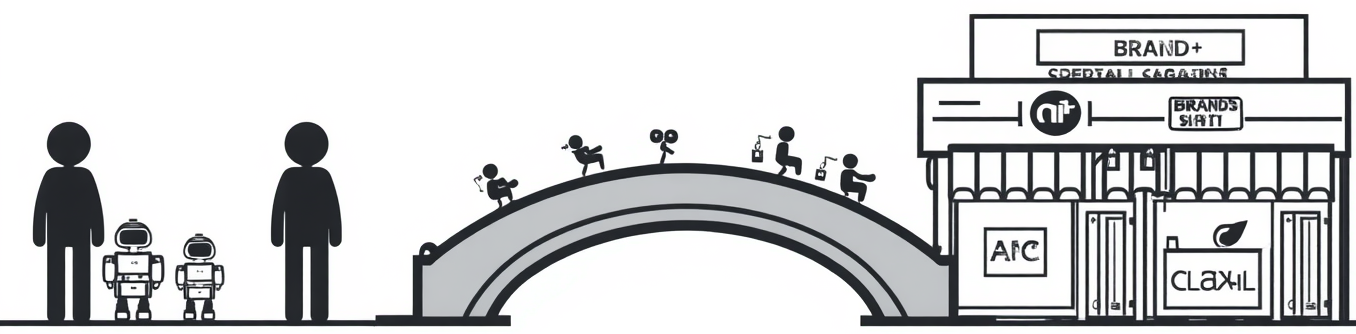
“The AI Purchase Channel is the new buying channel where the cognitive work of buying — research, comparison, defensibility checks, choice — has moved out of the shopper’s head and into AI. Sometimes the shopper stays in the conversation, asking ChatGPT, Gemini, or Perplexity for help. Sometimes they hand the whole job to a personal AI agent — OpenClaw, Hermes, or a custom build — and step back. Either way, the decision now happens inside AI. The channel is being run on borrowed instruments and inherited assumptions. This field guide is a map for the operator running it as a channel for the first time.”
Slingso, The AI Purchase Channel: A Field Guide
In the last six months, three things stopped being theoretical. Perplexity now triggers a shopping result on 92% of consumer queries that touch a product — six months ago that number was 40%. ChatGPT renders shopping cards inline for queries it would have answered with prose a year ago, and the cards include one or two recommended options, not ten. One in five online orders placed in the categories we monitor — premium skincare, supplements, consumer electronics — is initiated from a query made inside an AI assistant rather than a search box. The channel exists. The argument about whether it exists is over. The argument that matters now is how to operate inside it.
This is a field guide, not a manifesto. Manifestos pretend the channel is going to require fundamentally new skills. It will mostly require old skills, applied with sharper instruments, in a category that doesn’t yet have a vocabulary or a measurement stack of its own. The brands that move first in the next twelve months will spend the next decade explaining how they got such a head start. The brands that wait will spend the same decade trying to acquire customers in a channel that has already chosen its winners.
Below is what we have observed running this channel for ourselves and a small set of brands. It is organised the way a new operator would need to read it: what the channel is, how the offload happens, what it rewards and doesn’t, how to measure it, what the first thirty days look like, and why this is the moment.
What is the AI Purchase Channel?
The AI Purchase Channel is the new buying channel where the cognitive work of buying — research, comparison, defensibility checks, choice — has moved out of the shopper’s head and into AI. The query is conversational, the answer is opinionated, the recommendation is one or two options rather than ten. The shopper, having received the recommendation, either pursues it, asks for alternatives, or hands the rest of the job over. The transaction may complete inside the assistant (ChatGPT shopping cards, Perplexity buy buttons), off it (the shopper clicks through to the brand’s storefront), or via an agent acting on the shopper’s behalf (a connected agent runs the checkout). Either way, the assistant or the agent is where the buying decision was made.
This is not “AI for SEO.” This is not “AI for product discovery.” This is not a marginal addition to the marketing stack. It is a buying surface. It has its own decision dynamics, its own memory, its own modes of offload, and — as we will argue — its own metrics. Treating it as anything smaller will produce predictable disappointments.
What makes it a channel, not a tactic?
A channel has four things a tactic does not. It has a stable population of shoppers who return to it. It has decision dynamics that are characteristic of the surface — different from other surfaces in ways the brand can name. It has its own measurement vocabulary that, eventually, the industry will agree on. And it has an operator role inside the brand whose job is to win in it.
Google had these things by 2008 — a stable population (people searching), characteristic dynamics (ten links, click-through behaviour, query intent), a measurement vocabulary (impressions, clicks, rank, CTR, conversion), and an operator role (the SEO lead). Amazon had them by 2014 — a stable population (high-intent shoppers), characteristic dynamics (product cards, Buy Box, reviews-as-recommendation), a vocabulary (BSR, ACOS, share of voice, organic vs sponsored), and an operator role (the Amazon brand manager).
The AI Purchase Channel has the first three already. The shopper population is real and growing. The decision dynamics are characteristic — opinionated recommendation, persona conditioning, recency-weighted retrieval, assistant memory across sessions. The measurement vocabulary is forming this year. (We argue for two specific terms below — Narrative Accuracy and Purchase Likelihood — because those are the metrics the channel’s behaviour actually demands.) What it does not yet have inside most brands is the fourth thing: an operator whose job is to win in it. Most brands have a marketing lead who is “also paying attention to AI,” in the way most brands had a marketing lead “also paying attention to Google” in 2004. The brands that built the dedicated role first won the next decade. That move is open in this channel for one more year.
If the team’s most senior conversation about AI assistants is happening in the same meeting as social media tactics and influencer briefs, it is being treated as a tactic. That is the symptom.
The offload — two modes
The most important thing to understand about this channel is the offload. The cognitive work of buying — research, comparison, defensibility checks, choice — has moved out of the shopper’s head and into AI. The shopper is still always a human: they want the thing, they pay, they receive it, they are satisfied or not. What changed is where the deciding happens.
It happens in one of two modes.
The first is assisted. The shopper stays in the conversation, consulting an AI assistant — ChatGPT, Gemini, Perplexity, Google AI Mode — and decides with its help. They read the answers, ask follow-ups, apply their own taste and budget. The AI is doing the heavy work of comparison and evidence-gathering; the human is doing the final pass.
The second is delegated. The shopper hands the whole task to a personal AI agent — OpenClaw, Hermes, a custom build — and steps back. The agent does the research, the comparison, increasingly the transaction. The human supervises lightly or not at all. The same shopping job a person used to do at 11pm on a Tuesday is now happening in parallel, on a server, while they sleep.
Both modes look like the same thing from the brand’s side. The decision is being made inside AI, not inside the shopper’s head. The brand has to be legible to two audiences inside one interaction: the human, who reads emotionally and stays in the conversation when the stakes are high; and the AI, which reads literally and decides on evidence. The brand whose copy reads well only to a distracted human, but not to the AI doing the work, will be partially invisible in the assisted mode and entirely invisible in the delegated mode. Within two years, that math is fatal.
The two readers condition differently and the brand work has to account for both.
The human reader conditions strongly on tone, narrative resonance, packaging cues that come through in the assistant’s prose, and the assistant’s confidence. Two recommendations of equal accuracy can land differently because one is delivered as “I’d suggest” and the other as “you might consider.” Humans buy from the confident one.
The AI reader conditions strongly on structured fact density — ingredient lists, dimensions, certifications, schema-marked claims, verified reviews, recency of the source, personalisation cues for the user it is acting on behalf of. It is unmoved by tone. It will pass over a brand with beautiful copy but no structured data, and pursue a brand with sharper structured data even if the copy is plainer. Brands that built for human emotional resonance and skipped the structural work are partially invisible to this second reader, and the delegated share of this channel is growing every quarter.
The implication is not “drop the narrative work.” The implication is “do both kinds of work, deliberately, because the channel has two readers in one interaction.” Brands that pick one will be partly invisible to the half of the shopping volume that conditions on the other.
What does the AI Purchase Channel reward?
Three things, consistently, across categories and platforms.
Specificity. The assistant is making a recommendation, and the most useful recommendation is the most specific one. A brand that has done the work to be exactly the answer to a precise persona-and-scenario combination will be recommended for that combination. A brand that reads as the generic answer to a broad category — “a popular vitamin C serum,” “a well-known protein powder,” “a leading wireless charger” — will be mentioned in the preamble and skipped in the recommendation. The encyclopaedia layer of the assistant’s response is for generic brands. The recommendation layer is for specific ones.
This is the structural reason new brands win this channel and giants don’t. New brands are usually built around a sharp specificity — a precise ingredient claim, a precise customer, a precise use case. Giants are horizontal by design — they sell across personas, price tiers, and scenarios. Horizontal positioning loses in a channel that recommends, because the recommendation has to be narrow (heavily personalised for the user) to be useful.
Memory. Assistants maintain memory — within a session, across sessions for logged-in users, and (in some configurations) across the model’s training corpus. A brand that has been the recommendation for a specific shopper before is more likely to be the recommendation for that shopper again. More importantly, a brand that has been the recommendation in the model’s training and retrieval substrate — third-party reviews, owned content with strong schema, structured citation in trusted sources — has memory in the model itself. Memory is a moat that compounds. It is also a moat the brand can shape, slowly, by being precise and consistent about its narrative in every owned and earned source.
Being right. The assistant has incentive to be accurate; its core product promise depends on it. If a brand’s owned content makes claims that are precise, current, and verifiable, the assistant will lift those claims. If a brand’s owned content is vague, the assistant will improvise from whatever third-party scraps it has indexed — and the improvisation will often be wrong. Brands that have done the work of getting the narrative exact in their own surfaces are rewarded by the assistant in a way brands with elastic, aspirational copy are not. The assistant reads literally. It rewards brands that have written literally.
These three are the rewards. They are not glamorous. They are not new. They are what the channel happens to amplify because of the way the recommendation surface works.
What does it not reward?
The list is longer, and the operator’s instinct will be to keep doing several of these because they worked elsewhere. We will publish a tactical essay on what not to spend. The short version, for this guide:
The AI Purchase Channel does not reward generic SEO content (the assistant ranks owned authority on specifics, not on volume of generic posts). It does not reward retargeting (the assistant is not displaying ads against the query). It does not reward discount-led promotions (the assistant rarely surfaces promotional language; the recommendation logic is about personalisation, not price drop). It does not reward influencer follower counts (the assistant weighs review substance and verified reach, not headline follower numbers). It does not reward broad domain authority in the search-era sense (per-claim authority on the specific claim that’s being made matters more than aggregate site authority). It does not reward ad spend in any direct form — the assistant is not running an auction against the query.
These are not value judgements about the tactics. They remain useful in their native channels. They are, with one or two exceptions, useless inside this one. A brand reallocating budget into the AI Purchase Channel should know which existing line items are off the table for this surface, and which need to be re-invented for it.
How do you measure the AI Purchase Channel?
The channel does not yet have an agreed-upon measurement stack. The instruments most brands are using were imported wholesale from search and PR: visibility and ranking from the search era; share of voice from the PR era. Both are misreading the channel in characteristic ways. We have argued the case for two replacements, in detail, in two prior essays. The summary lives here, because the field guide should include the measurement vocabulary.
The channel demands a two-leg measurement triangle today — and a third leg, Intervention Impact, which we will introduce in a later essay. The two legs that operate now:
Purchase Likelihood — the revenue layer. The probability that, in a defined persona-and-scenario query inside the channel, an AI assistant recommends your brand (in the assisted mode) or an AI agent selects your brand (in the delegated mode). It is per-persona, per-platform, per-scenario, and it uses a recommendation classifier to distinguish “the AI mentioned you” from “the AI recommended you” or “the agent chose you.” Most brands measuring AI today are measuring visibility, which counts mentions and conflates the three; PL is the smaller, harder, decision-relevant number that maps to revenue. (Read the full case for Purchase Likelihood over visibility and ranking.)
Narrative Accuracy — the brand-value layer. The degree to which an AI assistant’s claims about your brand — ingredients, positioning, price point, persona, provenance — are true to your owned positioning. It decomposes to Coverage (the share of the assistant’s claims about you that traces back to your owned content) and Correctness (the share of those claims that are true). In the assisted mode, NA shapes what the human reads about you. In the delegated mode, NA is the input the agent acts on. Most brands measuring AI today are measuring share of voice, which counts mentions and cannot tell a flattering mention from a libellous one; NA is the metric that distinguishes brand-building mentions from brand-eroding ones. (Read the full case for Narrative Accuracy over share of voice.)
A brand reading both metrics across its core personas and scenarios, on each major platform, has a complete picture of who the channel is sending to it (PL) and what the channel is saying about it (NA). The gaps are diagnostic. PL low and NA high: the brand is being described accurately but isn’t being chosen for any persona — usually a positioning sharpness problem. PL high and NA low: the brand is being chosen but described as something it isn’t — usually a brand equity problem that compounds. PL low and NA low: the brand is invisible and misrepresented when seen — the most common starting position, and the one with the most leverage on first repair.
The operator who runs this channel on visibility and share of voice alone is reading the wrong instruments. The operator who runs it on PL and NA is reading the channel.
The operator’s first thirty days
What a brand should actually do in the channel for the first month. This is the field guide section a new operator can act on tomorrow.
Days 1–7: baseline. Decide on three to five personas that match the brand’s core customers — a way to identify these personas is to use the Audience in the ads setup (Google, Meta, etc.) that is converting per your goals. Decide on five to ten scenarios per persona — actual queries a real shopper might say, not category keywords. (“I’m 38, sensitive skin, looking for a daily vitamin C serum under $40 that won’t react with retinol” — not “vitamin C serum.”) Run those queries across ChatGPT, Gemini, Perplexity, and Google AI Overviews. Record PL — how often the assistant recommends the brand, not just mentions it. Record NA — when the assistant talks about the brand, what does it say, and how accurate is it. Build the simple matrix: persona × scenario × platform.
Days 8–14: read the matrix. Find the worst cell — the persona-scenario-platform combination where the brand is least recommended, or where the assistant’s description is most off. Find the best cell — where the brand is most recommended and most accurately described. Most operators are surprised by both. The worst cell is rarely where they thought it would be. The best cell is rarely the one their go-to-market team has been investing in.
Days 15–21: ship one specific repair. Pick one cell from the worst tier and fix the narrative inputs the assistant is pulling from. This is usually a product page rewrite (to anchor the claims the assistant is improvising), a schema markup update (to give the AI reader structured fact density), a verified review push for a specific persona-scenario combination, or a third-party source repair (asking a reference site to update an outdated claim). One specific intervention. Not a content overhaul.
Days 22–30: re-measure and learn. Re-run the same queries from Days 1–7. Did PL move in the cell you repaired? Did NA improve? Most repairs are visible inside two weeks for retrieval-based assistants (Perplexity, Gemini, ChatGPT with browsing, Claude, OpenClaw, etc.) and inside one to three months for model-substrate behaviour (ChatGPT default behaviour, model recall). The team now has its first piece of channel-specific learning: what kind of intervention moved this kind of metric on this platform for this persona. That learning compounds.
After thirty days, the operator has a measurement baseline, a diagnostic matrix, one shipped intervention, and a measurable result. That is what the first month of the channel should produce. Not a strategy deck. Not a competitive audit. Not a tools evaluation. A baseline, a repair, and a measured outcome.
Why now?
Channel restructurings are slow at the surface and fast underneath. The shift from Yellow Pages to Google was visible to operators in 2004 and visible in revenue lines by 2010. The shift from Google to Amazon was visible to operators in 2014 and visible in revenue lines by 2018. The pattern is consistent: the inflection takes five to seven years to be obvious in the income statement, and the brands that moved in years one and two of the inflection won the next decade. The brands that waited for the income statement to tell them spent the rest of the decade buying customers in the new channel at the prices set by the brands that moved first.
We are, by our reading, in year two of the AI Purchase Channel inflection. Perplexity’s product behaviour, ChatGPT’s shopping integration, the rapid maturation of the delegated mode, and the 92%-of-consumer-query threshold are not the inflection itself — they are the surface signal that the inflection is well underway. The brands that build the operator role, the measurement baseline, and the first thirty days of channel-specific learning in 2026 will be unreachable to most competitors by 2028.
This is the moment a discipline gets named. AI Purchase Channel is the name we propose. Whether the industry agrees on this label or another, the underlying channel does not need anyone’s permission to exist. It is already doing the recommending. The question is who is running it for the brand, and how they are reading what it does. A brand without that operator in the next twelve months is a brand whose share of channel revenue is being decided by the model’s defaults rather than by the brand’s intent.
The field guide is for the operator who is taking the channel seriously. There will be more essays — on what the channel doesn’t reward, on why new brands win it, on the delegated mode in depth, on the lived history of the prior channel restructurings, on the third metric, Intervention Impact. The map will get sharper. The territory is already underneath us.
Frequently asked Questions
What is the AI Purchase Channel? The AI Purchase Channel is the new buying channel where the cognitive work of buying — research, comparison, defensibility checks, choice — has moved out of the shopper’s head and into AI. Sometimes the shopper stays in the conversation, asking ChatGPT, Gemini, or Perplexity for help (the assisted mode). Sometimes they hand the whole job to a personal AI agent — OpenClaw, Hermes, or a custom build — and step back (the delegated mode). Either way, the decision happens inside AI. (Read the canonical definition.)
Is the AI Purchase Channel the same as the AI Shopping Channel? Functionally, yes — they name the same surface. We use AI Purchase Channel because the recommendation behaviour is what makes the channel structurally distinct from search and from marketplaces; “shopping” is a broader term that gets used about discovery, browsing, and cart-building in ways that conflate three different jobs. The precise name is AI Purchase Channel. We will use the two interchangeably when speaking to operators who came in through the “AI shopping channel” framing.
How is the AI Purchase Channel different from AI search? AI search returns information; the AI Purchase Channel returns product recommendation (and likely a buy link) for complex scenarios. The shopper inside this channel is not asking for ten links — they are asking what to buy, and the assistant is returning one or two opinionated recommendations. The channel is opinionated by default, persona-conditioned, and memory-aware. AI search is an upstream behaviour; the AI Purchase Channel is a buying surface.
What are the two modes of the AI Purchase Channel? Assisted — the shopper stays in the conversation with an AI assistant (ChatGPT, Gemini, Perplexity, Google AI Mode) and decides with its help. Delegated — the shopper hands the whole task to a personal AI agent (OpenClaw, Hermes, a custom build) and steps back. Both modes mean the deciding has moved out of the shopper’s head and into AI. The brand has to be legible to both — to the human (who reads emotionally) and to the AI (which reads literally) — inside the same interaction.
How do you measure the AI Purchase Channel? With two metrics today, with a third coming. Purchase Likelihood is the revenue-layer metric — the probability that, in a defined query, an AI assistant recommends (or an AI agent selects) your brand, not just mentions it. Narrative Accuracy is the brand-value-layer metric — when the assistant talks about your brand, is what it says true to your positioning. Most brands today are still measuring visibility and share of voice, both of which were built for prior-era channels and misread this one. Intervention Impact — the third leg — measures how a specific brand intervention moved PL and NA, and gets its own essay later.
What should the operator do in the first thirty days? Define three to five personas and five to ten scenarios per persona. Baseline PL and NA across ChatGPT, Gemini, Perplexity, and Google AI Overviews. Read the persona × scenario × platform matrix. Pick the worst cell. Ship one specific narrative repair — product page, schema, verified review, third-party source. Re-measure. Learn what moved. That is the month one outcome: a baseline, a repair, a measured result.
Who runs the AI Purchase Channel inside a brand? A dedicated operator — the way Google had an SEO lead by 2008 and Amazon had a brand manager by 2014. Most brands today do not yet have this role; they have a marketing lead who is “also paying attention to AI.” The brands that build the dedicated operator role in the next twelve months will be unreachable to most competitors by 2028. Slingso is the AI Purchase Channel Manager — the AI team member a brand onboards as the dedicated owner of this channel. Five loops run continuously: Monitor (what is AI saying about your brand?) → Analyse (why aren’t we the recommendation?) → Create (what should we ship to fix it?) → Approve (will you sign this off?) → Measure (did it move the needle?). Your existing team focuses on the strategic items; Slingso does the channel work day-in, day-out.
The two companion essays:
- Purchase Likelihood vs Visibility and Ranking — the revenue-layer metric the channel demands.
- Narrative Accuracy vs Share of Voice — the brand-value-layer metric the channel demands.
Read the AI Purchase Channel page — the canonical definition this field guide expands on.
Slingso is the AI Purchase Channel Manager — the AI team member your brand onboards as the dedicated owner of the channel. Monitor → Analyse → Create → Approve → Measure, continuously.